Contents
- Overview
- Conservation Project Planning and Promotion
- Vegetation Establishment and Maintenance
- Invasive Species Control
Categories
- General Invasive Species Control Information
- Hybrid and Narrow-leaf Cattail Control
- Purple Loosestrife Control
- Reed Canary Grass Control
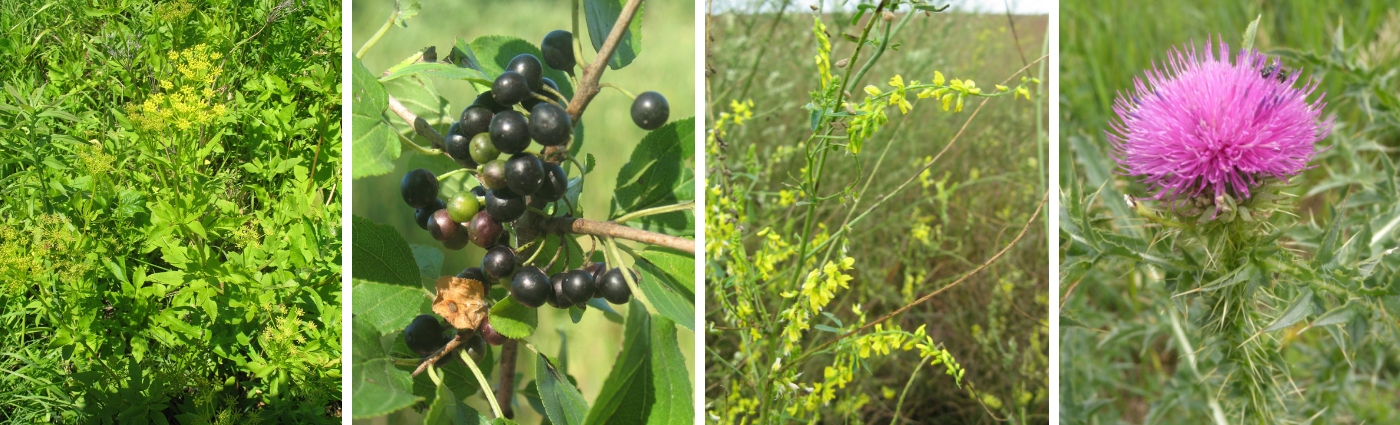
- Common and Glossy Buckthorn Control
- Common Reed Grass Control
- Canada Thistle Control
- Crown Vetch and Bird's Foot Trefoil Control
- Sweet Clover Control
- Wild Parsnip Control
- Spotted Knapweed Control
- Garlic Mustard Control
- Carp Management
General Invasive Species Control Information
The 2011 Minnesota DNR Invasive Species Program Annual contains information about individual invasive species and control methods/efforts. The report is found at: http://files.dnr.state.mn.us/eco/invasives/annual_report_2009.pdf
-Development of Cooperative Weed Management Areas to promote partnerships for the management of invasive species across boundaries.
-Biological control, the use of natural enemies to control non-native pests, can be an effective tool in managing invasive plants. Non-native plants can become invasive because they lack the insects and diseases that control them in their native environments. Biological control reunites natural enemies, such as herbivores and pathogens, with their host (invasive plant) to reduce impacts caused by the pest. The goal of biological control is to reduce the target pest population and its corresponding impact to an acceptable level. The Minnesota Departments of Agriculture (MDA) and Natural Resources (DNR) have implemented successful biological control programs for leafy spurge, spotted knapweed, and purple loosestrife statewide. Development of new biological control efforts for garlic mustard, buckthorn and common tansy are underway. Our programs utilize specialized insects that were tested extensively for host specificity (safety) and efficacy.
Biological control programs in Minnesota are cooperative. Multiple agencies, associations, institutions, and private landowners work together to accomplish goals. Lead agencies help to coordinate efforts, disseminate information, provide expertise, and collect data. (Monika Chandler, Minnesota Department of Agriculture)
-We have gotten a lot of help in maintenance of public park restorations in from the Sentence-to-Serve program that is part of the County Sheriff Department. The crews have helped with such work as dragging cut buckthorn, pulling mullein, root chopping sweet clover and bird’s-foot trefoil and more. This helps to keep the project cost down considerably (Gina Hugo, Sherburne SWCD).
-The following webpages provide valuable information about Cooperative Weed Management Areas and invasive species control.
- IPAW - www.ipaw.org note it includes a section on CWMAs called "Regional invasive plant groups". Also includes archives of our newsletters with articles on ongoing projects. Our extensive reed canary publication is also on this site. The nursery/consultants list that is on there is a bit out of date. We'll be updating it this winter.
- MIPN - www.mipn.org - be sure to include a link from your site to the "CWMA Resources" here. Kate Howe is coordinating a revision of the MIPN CWMA cookbook and would appreciate any feedback you could provide. Other useful info here includes many publications, power points and conference abstracts
- WI DNR Invasives page - http://www.dnr.state.wi.us/invasives/ Our entire website is undergoing a major revamping, so this URL will soon be changed. you may want to wait a month or so to make links to this site. Lots of publications, fact sheets (we have new ones we will be putting on the new site), photos (keep the credits attached if you use them).
Also, Mark Renz's lab at the UW Madison Agry Dept is developing new fact sheets focused on control with lots of details about what herbicides to use for what plants. http://ipcm.wisc.edu/Publications/WeedSciencepublications/tabid/116/Default.aspx
(Kelly Kearns, Wisconsin Department of Natural Resources) - Information about invasive species control information from the Pope Cooperative Weed Management Area can be found at: http://weedwatchers.org/index.cfm/pageid/65
Hybrid and Narrow-leaf Cattail Control
-Establishment of aggressive emergent plants before cattails become established.
-Pulling of young plants before extensive root systems develop.
-Application of aquatically certified glyphosate or Imazapyr herbicide directly to foliage (permits must be obtained first).
-Cutting stems low to the ground in the fall and winter and then raising water levels (with spring snowmelt) at least a few inches above growing vegetation. This technique depends on the ability to collect and hold water within a wetland.
Purple Loosestrife Control
-Hand pulling seedlings or using a garden fork to pull out individual mature plants.
-Application of aquatically certified glyphosate directly to foliage before flowering. If flowering, heads can be cut and bagged and herbicide applied directly to cut stem.
-Use of leaf eating beetles to defoliate plants. This technique works best in dense stands (http://www.dnr.state.mn.us/invasives/aquaticplants/purpleloosestrife/index.html).
Reed Canary Grass Control
-A sequence of late summer mowing, late fall (Late September to mid October) application of 3% glyphosate (aquatically certified glyphosate if standing water is present), early spring prescribed burning and repeated glyphosate application in the spring/summer as needed (http://www.lrrb.org/pdf/200436.pdf).
-A combination of weed whipping flowers to prevent seed production, dormant overspray with an aquatic formulation of glyphosate, and spot treatment with glyphosate and sethoxydim (during dry periods) has led to a dramatic reduction in reed canary grass cover and a substantial increase in three square bulrush abundance in a lakeshore/wet meadow restoration (Ramsey Washington Metro Watershed District).
-Combinations of spring tilling and herbicide application.
-Periodic late fall (after killing frost) applications of glyphosate in stands of warm season native species (other natives may be affected).
-Use of grass specific herbicide to remove seedling reed canary grass (grass specific herbicides are not aquatically certified). (http://na.fs.fed.us/spfo/invasiveplants/downloads/index.asp and select "Effects of a selective herbicide, Sethozydim, on reed canary grass").
-Scraping to 8-12 inches to remove reed canary grass mat. Full removal of rhizomes is needed. This technique should only be used where there is expendable soil, preferable where sediment has accumulated.
Common and Glossy Buckthorn Control
The following information summarizes input from landowners who participated in a cost-share program. We are also creating a web-page with Frequently Asked Questions: http://www.mnwcd.org/land_habitat_restoration_invasive.php
-Based on input from our local residents: Young seedlings (less than 2 years old) are sensitive to repeated cutting. Be sure to cut (and treat) larger stems low, to allow for later mowing.
-Mesic oak-aspen woods community appears to be relatively resilient and able to regenerate, when buckthorn is controlled. Delay replanting until you see what returns naturally (See photo).
-Broadcast spraying of groundlayer is not selective; it will kill more than just buckthorn, and can have residual effects suppressing the desired regrowth.
-Cutting of large buckthorn will release seedlings. Without follow-up (such as mowing and/or herbicide stump treatment) this just compounds the problem.
-Basal bark or hack-and-squirt methods kill slowly. Seed production drops off the first year, but the tree may survive for several years.
-Providing loaner tools, such as Weed Wrenches. The tools are purchased through grants or by partner agencies, and are loaned out at no charge, other than a refundable deposit. Landowners typically pick up the tool mid-week and use it through the weekend. If it's working well, they might consider purchasing one of their own, or they re-sign up for the loaner pieces.
-Regarding grants (not limited to buckthorn): Without a commitment to the end goal, grant funding for a single episode of management might not show adequate results. In reviewing prospective landowner/participants, it helps to evaluate their previous accomplishments.
-Regarding invasive species (not limited): Managing invasive species is tedious; recognition and reinforcement of landowners' efforts are very important.
-Simple but effective education efforts include displays of live specimens, such as a planting bed or vase in public view.
-Simplified factsheets, such as a short comparative list of herbicides or vendors, help landowners make choices, and are worth the time spent by staff on creating the summaries. (Jyneen Thatcher, Washington Conservation District).
-Managing buckthorn in the fall after other trees and shrubs have lost their leaves (www.dnr.state.mn.us/invasives/terrestrialplants/woody/buckthorn/index.html).
-Educating landowners about the need to treat stumps after removal (Redwood SWCD).
-Targeting fruiting buckthorn first to prevent future spread.
-Pulling seedling buckthorn when soils are moist, using weed wrenches or other tools to aid removal.
-Cutting large buckthorn and treating with 50% glyphosate (aquatically certified glyphosate in wetlands).
-Basally treating the lower 10 inches of sapling and larger buckthorn with Garlon 4 in the dormant season. 10-20 percent mixes for smaller trees and 40 percent mixes for larger trees (www.smm.org/scwrs/publications/rendezvous/2005/basalbark/).
-Using prescribed fire to control seedlings when sufficient fuel (dead plant material) is available to carry a burn.
-Using Krenite herbicide (bud inhibitor) with soft water to control seedling herbicide.
-Propane torch for burning seedlings.
Common Reed Grass Control
-Application of aquatically certified glyphosate or Imazapyr to upper foliage during flowering, mowing or prescribed burning in the spring followed by additional herbicide treatments as needed (http://www.michigan.gov/documents/deq/deq-ogl-ais-guide-PhragBook-Email_212418_7.pdf).
Canada Thistle Control
-In plantings where primarily warm grass species were planted and early succession forbs are absent, thistles have no competition and often reach maturity before warm season grasses like big bluestem and Indian grass even start to green up. Having a strong Canada wild rye component as well as composite forbs, like black eyed Susan and Yellow coneflower seems to put pressure on thistle populations (Martin SWCD).
-For high quality communities, hand pulling or careful wick application of clopyralid herbicide.
-Spot treatment of thistle early in development before it has a chance to spread.
-Push Canada thistle control with spot spraying rather than whole field spraying when forbs are present (Redwood SWCD).
-Renville SWCD has developed a landowner handout giving recommendations regarding chemical control for Canada thistle as they have nearly 400 RIM/PWP/CREP easements requiring management. The SWCD strongly recommends Milestone application in both spring and fall and has found that to be the only effective way to control thistles. The handout works for not only landowners, but is also given to other interested parties and to Township Boards as they try to administer the Noxious Weed Law.
(Renville SWCD).
Crown Vetch and Bird’s Foot Trefoil Control
-Repeated pulling in sand or moist soils.
-Mowing in late spring successive years.
-Triclopyr or glyphosate herbicide at 2% by volume concentration applied to foliage in early spring.
-Spring burns successive years.
Sweet Clover Control
-Spring burns successive years. First burn before green-up of plants to stimulate seed germination the first year. Conduct low intensity burn the following spring when plants are 6-10 inches high.
-Pulling by hand in sandy or moist soils.
Wild parsnip Control
-I have been removing wild parsnip from approximately 6 acres every year since 2006, by hand pulling. Removal has been thorough, with essentially all seed-bearing plants, and hence seed deposition, eliminated each year. The plants are primarily located along woodland trails, in a wet meadow and along a restored prairie edge, all of which have a history of mowing. It seems probable that the plant was introduced to this isolated site by mowing with a contaminated mower.
I have counted all plants as they are weeded. Over five years plant numbers have decreased from 8,000 in 2006 to 2,000 in 2010. As of August, 2010, juvenile plants were still visible in moderate abundance, primarily in the meadow. As these plants mature and are removed in the next year or two, I expect that abundance will continue to decline.
Long sleeves and gloves are required. Try to get the plants before the seed is viable. Dispose of the seed-bearing plants where there is no danger of seed germination. Based on my experience, I suspect that seed longevity estimates might be somewhat low. The youngest plants at this site originate from seed dropped no later than 2005. A parsnip predator reduces labor slightly and eliminates broken stems. Do not use it on anything other than parsnip, though, as the tool is not sturdy enough for larger plants. (Hugh Valiant, Minnesota Department of Natural Resources)
-Cutting root 1” below ground, being careful to avoid touching cut vegetation as it can cause severe blisters.
-Repeated mowing starting when the plant starts to flower. In some cases mowing can cause more harm than good; if mowing early in the year wild parsnip will re-sprout like a stump sucker on a tree sending out 2-3 plants (Wright SWCD).
-Glyphosate (2%) or 2,4D treatments to basal rosettes March to May or August to October.
-Effective herbicides include 2,4-D and Weed-B-Gone (until plants reach 8-inches), Curtail and Crossbow (with a surfactant), Round Up and Ranger (all effective from early spring until plants turn woody and produce viable seed) (Wright SWCD).
-Once the plant has gone to seed and is viable, cutting the tops of the plants with a scissors or clipper and bagging the seed, and burning will reduce the number of viable seeds (Wright SWCD).
Spotted Knapweed Control
-Pulling individual plants before flowers develop. Pull when soils are moist to avoid breaking roots.
-Application of Clopyralid or Aminopyralid herbicide on rosettes in the fall and early spring and mature plants in late spring early summer prior to flowering (Tony Cortilet, Minnesota Department of Agriculture)
-Information about biological control for spotted knapweed can be found on the MDA website at: http://www.mda.state.mn.us/en/plants/badplants/knapweed.aspx (Tony Cortilet, Minnesota Department of Agriculture)
Garlic Mustard Control
-Pulling in moist soils before flowers develop.
-Glyphosate herbicide application to foliage in spring before flowering. Or treatment in late fall or early spring after frost, when rosettes are active but other plants are dormant.
Carp Management
-The RWMWD entered a partnership with Dr. Sorensen, University of Minnesota, to study common carp in the Phalen Chain of Lakes Watershed. Past research has suggested that this fish species can substantially influence water quality, especially in shallow lakes. The main objectives of the research are to: 1) determine the abundance of carp; 2) evaluate the potential effects of carp on nutrient cycling; and 3) assess whether game-fish might be used to control carp. The Legislative-Citizen Commission on Minnesota Resources (LCCMR) is partnering with the watershed to fund this work. For more information, please visit: www.rwmwd.org/carp (Bill Bartodziej, Ramsey-Washington Metro Watershed District).